Instant film types explained
Seven film formats, none of them interchangeable. Here is what each one measures, which cameras take it, and what it costs — in one place.
There are seven instant film formats in production: instax mini (62 x 46 mm), SQUARE (62 x 62 mm) and WIDE (62 x 99 mm), plus Polaroid i-Type, 600 and SX-70 (all 107 x 88 mm) and Polaroid Go (66.6 x 53.9 mm). None is interchangeable with another.

How this page is funded. Shake & Print earns a commission when you buy through our links, at no extra cost to you. It does not change which products we pick or the order we rank them in, and we do not state prices we have not verified — the buy buttons send you to the current listing instead. Full disclosure.
The seven formats at a glance
| Format | Picture size | Print size | ISO/ASA | Develop | Per shot |
|---|---|---|---|---|---|
| instax mini | 62 x 46 mm (2.4 x 1.8 in) | same | 800 | ~90 sec | $0.85 |
| instax SQUARE | 62 x 62 mm (2.4 x 2.4 in) | 86 x 72 mm | 800 | ~90 sec | $1.15 |
| instax WIDE | 62 x 99 mm (2.4 x 3.9 in) | same | 800 | ~90 sec | $1.10 |
| Polaroid Go | 47 x 46 mm | 66.6 x 53.9 mm (2.6 x 2.1 in) | 640 | 10-15 min | $1.37 |
| Polaroid i-Type | 79 x 77 mm (3.1 x 3.0 in) | 107 x 88 mm (4.2 x 3.5 in) | 640 | 10-15 min | $2.37 |
| Polaroid 600 | 79 x 77 mm | 107 x 88 mm | 640 | 10-15 min | $2.62 |
| Polaroid SX-70 | 79 x 77 mm | 107 x 88 mm | 160 | 10-15 min | $2.75 |
The instax family
instax mini — 62 x 46 mm
The most common instant film in the world. About the size of a credit card, ISO 800, developing in about 90 seconds, and about 85 cents a shot from a 20-exposure twin pack. It is the only instant film regularly stocked in supermarkets and drugstores.
Cameras: instax mini 13, mini 12, mini 41, mini 99, mini Evo, mini LiPlay. Printers: instax mini Link 3.
instax SQUARE — 62 x 62 mm picture on 86 x 72 mm film
The square format, with the white border people associate with instant photography. Note the two dimensions: the picture is 62 x 62 mm, but the sheet is 86 x 72 mm, so there is a wider border at the bottom. ISO 800, about 90 seconds, and about $1.15 a shot — the most expensive instax film.
Cameras: instax SQUARE SQ40, SQUARE SQ1.
instax WIDE — 62 x 99 mm
The large instax format, nearly twice the width of a mini print and the only one that comfortably fits a group. ISO 800, about 90 seconds, about $1.10 a shot — cheaper than SQUARE despite the much bigger print, and the best value of any instant film per square inch of picture.
Cameras: instax WIDE 400, WIDE Evo. Printers: instax Link WIDE 2.
The Polaroid family
Polaroid i-Type — 107 x 88 mm
The film for modern full-size Polaroids, and the one to buy if you have one. A 79 x 77 mm image area on a 107 x 88 mm sheet, ASA 640, developing over 10 to 15 minutes. Eight photographs a pack at $18.99 — about $2.37 each.
Cameras: Polaroid I-2, Flip, Mod, Now, Now+, OneStep 2, OneStep+. Printers: Polaroid Lab. It will not work in a vintage 600 camera, because i-Type packs have no battery and those cameras draw power from the pack.
Polaroid 600 — 107 x 88 mm
The same photograph as i-Type, in a pack that carries a battery so vintage 600-series cameras can use it. ASA 640, same development time, $20.99 for eight — about $2.62 each.
Cameras: Polaroid 600 series, plus every modern camera that takes i-Type. If your camera is modern, buy i-Type instead and save $2 a pack for an identical photograph.
Polaroid SX-70 — 107 x 88 mm, ASA 160
The original format, and the one that behaves differently. ASA 160 is roughly two stops slower than everything else here, so it needs considerably more light — bright daylight or flash. $21.99 for eight, about $2.75 each, the most expensive film on this site.
Cameras: Polaroid SX-70 and I-2 only.
Polaroid Go — 66.6 x 53.9 mm
Polaroid in miniature: a 47 x 46 mm image area on a 66.6 x 53.9 mm sheet, with the white border intact. ASA 640, 10 to 15 minutes, and sixteen photographs a pack at $21.99 — about $1.37 each, Polaroid's cheapest per shot.
Cameras: Polaroid Go only, and the Go takes nothing else. Worth knowing that most instant-photo albums do not fit Go prints — Polaroid sells a Go-specific album for that reason.
Printer media is not film
A separate category that gets lumped in with the above and should not be. These are printed photographs, not developing film — see how pocket photo printers work.
| Format | Print size | Pack | Pack price | Cost per shot | Checked at |
|---|---|---|---|---|---|
| Canon SELPHY 4 x 6 (KP-108IN) | 4 x 6 in | 108 | $41.99 | $0.39 | Pro Photo Supply |
| Kodak 4PASS 4 x 6 | 4 x 6 in | 80 | $31.99 | $0.40 | Kodak Photo Printer store |
| Kodak 4PASS 3 x 3 | 3 x 3 in | 60 | $24.99 | $0.42 | Kodak Photo Printer store |
| Kodak 4PASS 2.1 x 3.4 | 2.1 x 3.4 in | 60 | $24.99 | $0.42 | Kodak Photo Printer store |
| ZINK 2 x 3 | 2 x 3 in | 20 | $11.99 | $0.60 | ProCam |
| Canon SELPHY Square (XS-20L) | 2.7 x 2.7 in | 20 | $16.00 | $0.80 | ProCam |
| Polaroid Hi-Print 2 x 3 | 2 x 3 in | 20 | $16.99 | $0.85 | Polaroid |
Which format should you choose?
- No strong preference: instax mini. Cheapest, most available, adequate.
- Photographs with several people: instax WIDE. The only instax format that works for groups.
- You want the square shape: instax SQUARE for value, Polaroid for the real thing.
- You want the iconic print: Polaroid i-Type, and budget $2.37 a frame.
- You want pocketable: Polaroid Go, with the smallest print of any format here.
- You have a vintage camera: 600 film for a 600-series, SX-70 film for an SX-70. Check which before you buy.
Questions people ask
What are the instant film sizes?
instax mini is 62 x 46 mm (2.4 x 1.8 in), instax SQUARE is a 62 x 62 mm picture on an 86 x 72 mm sheet, instax WIDE is 62 x 99 mm, Polaroid Go is 66.6 x 53.9 mm, and Polaroid i-Type, 600 and SX-70 are all 107 x 88 mm (4.2 x 3.5 in).
Can I use instax film in a Polaroid camera?
No. The formats are physically and chemically different and are not interchangeable in either direction. Each camera takes exactly one film format for its entire working life.
What is the difference between i-Type and 600 film?
The photograph is identical — same 107 x 88 mm size, same ASA 640. The difference is that 600 packs carry a battery, so they work in vintage 600-series cameras that draw power from the pack. 600 film costs $2 more per pack, so there is no reason to buy it for a modern camera.
Why is SX-70 film different?
It is ASA 160 rather than 640 — roughly two stops slower — so it needs considerably more light than any other instant film. It fits only SX-70 and I-2 cameras, and at about $2.75 a shot it is the most expensive film in production.
Does Polaroid Go film fit other cameras?
No. Go film fits only the Polaroid Go, and the Go takes no other film. It is a closed format with a single supplier, and most instant-photo albums will not hold Go prints either.
Which instant film develops fastest?
All three instax formats, at about 90 seconds. Every Polaroid film takes 10 to 15 minutes and needs shielding from light while it develops — which is a practical difference at a party and part of the appeal for people who like the ritual.
Read these next
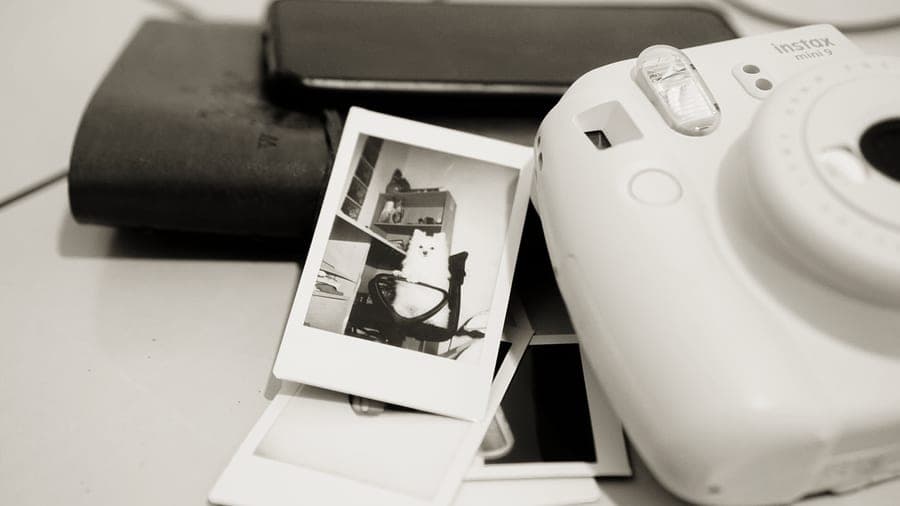
Every format compared on cost
The same formats, sorted by price per shot.

What to look for in an instant camera
The six specifications that matter, starting with the film.
Where to buy instant film
Which formats are easy to find and which are not.
Albums for instant prints
Matching an album pocket to the print size.
How pocket photo printers work
Why printer media is a different thing from film.
Sources
- Fujifilm instax mini 12 specifications — Confirms instax mini picture size 62 x 46 mm and ISO 800
- Fujifilm instax SQUARE SQ40 specifications — Confirms instax SQUARE picture size 62 x 62 mm on 86 x 72 mm film
- Fujifilm instax WIDE 400 specifications — Confirms instax WIDE picture size 62 x 99 mm
- Polaroid — Color i-Type film — $18.99 for 8 photos, image area 79 x 77 mm, ASA 640, 13 October 2026
- Polaroid — Color 600 film — $20.99 for 8 photos, 13 October 2026
- Polaroid — Color SX-70 film — $21.99 for 8 photos, ASA 160, 13 October 2026
- Polaroid — Go film — $21.99 for 16 photos, image area 47 x 46 mm, 13 October 2026
- Pro Photo Supply — instax mini film, 20 exposures — $16.99 on 13 October 2026
- Pro Photo Supply — instax SQUARE film, 20 exposures — $22.99 on 13 October 2026
- Pro Photo Supply — instax WIDE film, 20 exposures — $21.99 on 13 October 2026
- Kodak — 4PASS cartridges — $24.99 for 60 prints (2.1x3.4 and 3x3), $31.99 for 80 (4x6), $35.99 for 120 (4x4), 13 October 2026
- ProCam — Canon 2x3 ZINK paper, 20 sheets — $11.99 on 13 October 2026
- Pro Photo Supply — Canon SELPHY KP-108IN set — $41.99 for 108 prints at 4 x 6 in, 13 October 2026
Found something out of date or wrong? Tell us and we will correct it with a dated note. Our picks are re-checked quarterly — see our editorial policy.