The best hybrid instant cameras
A hybrid shoots digitally, shows you the photo on a screen, and only prints the ones you choose. On film that costs 42 to 85 cents a frame, that is the single biggest saving in the category.
The best hybrid instant camera is the Fujifilm instax mini Evo: a 3 inch screen, 100 effect combinations and real instax mini film, so nothing gets printed by accident. The budget pick is the Kodak Mini Shot 2 Retro, which prints for about 42 cents against the Evo's 85.
How this page is funded. Shake & Print earns a commission when you buy through our links, at no extra cost to you. It does not change which products we pick or the order we rank them in. Prices on the buy buttons come from Amazon and carry the date they were read; where we have no current price the button shows no figure. Full disclosure.
| # | Product | Best for | Cost per shot | Price |
|---|---|---|---|---|
| 1 | Fujifilm instax mini EvoA 3 inch screen, a hundred lens-and-film effect combinations, and real instax mini film — the hybrid that gets the balance right. | Best hybrid instant camera overall | $0.85 | $199.20 · View on Amazon |
| 2 | 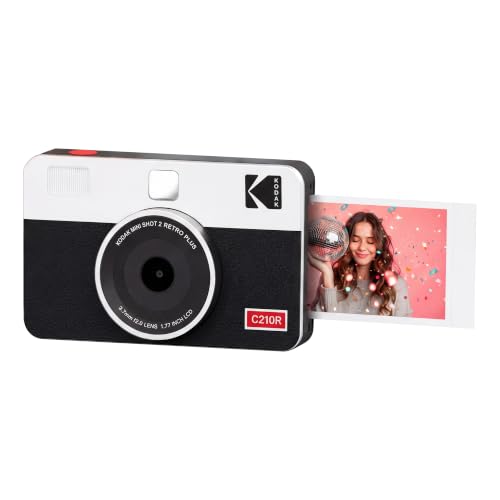 Kodak Mini Shot 2 RetroCamera and phone printer in one body on the cheapest media we have costed: about 42 cents a print, laminated and dry. | Budget pick — cheapest hybrid to buy and to run | $0.42 | $112.30 · View on Amazon |
| 3 | 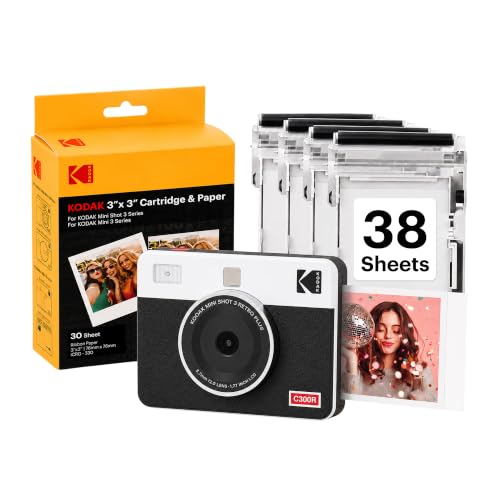 Kodak Mini Shot 3 RetroThe Mini Shot idea on a 3 x 3 inch square, still at about 42 cents a print — against $1.15 a shot for square instant film. | Best hybrid for square prints | $0.42 | $114.74 · View on Amazon |
| 4 | 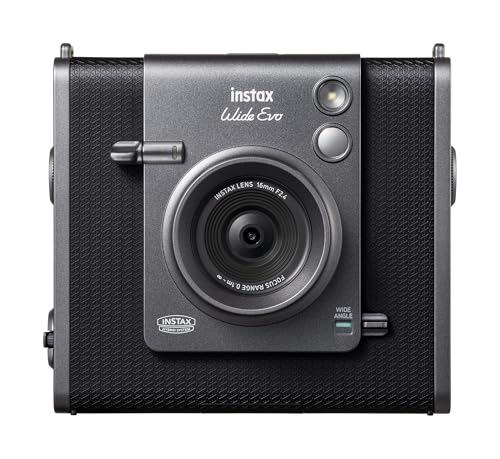 Fujifilm instax WIDE EvoThe mini Evo idea on the 3.9 x 2.4 inch WIDE print, with the widest lens instax has made. Also the most expensive instax you can buy. | Best hybrid for big prints | $1.10 | $360.00 · View on Amazon |
Prices as of November 28, 2026 and may change.
Every instant camera has the same flaw: you do not know whether the picture worked until it has already cost you money. On instax mini that is about 85 cents a mistake, and on Polaroid i-Type it is about $2.37. A hybrid fixes exactly that. It shoots to a digital sensor, shows you the result on a screen, and prints only what you point at — so the blinked eyes, the thumb over the lens and the three near-identical frames of the same cake cost nothing at all.
That makes the hybrid class the most economical way to own an instant camera, which is a strange thing to say about the most expensive bodies in the category. The hardware costs more and the pictures cost less, and over a year of ordinary use the second number is the bigger one.
What a hybrid saves, in actual money
Assume a camera gets used for 200 shots in a year, which is ten packs of film, and assume a fifth of those shots are duds — a conservative figure for a camera handed round at parties. On a film-only instax mini that waste costs about $34 a year. On a hybrid it costs nothing, because the duds are deleted instead of printed. On Polaroid i-Type the same 40 wasted frames would be about $95.
| Camera or printer | 40 shots | 100 shots | 200 shots |
|---|---|---|---|
| Fujifilm instax mini EvoHardware price not published — film cost only | $33.982 packs of instax mini | $84.955 packs of instax mini | $169.9010 packs of instax mini |
| Kodak Mini Shot 2 Retro$129.99 listed with a 38-sheet bundle (reg. $159.99) | $154.981 pack of Kodak 4PASS 2.1 x 3.4 | $179.972 packs of Kodak 4PASS 2.1 x 3.4 | $229.954 packs of Kodak 4PASS 2.1 x 3.4 |
| Kodak Mini Shot 3 Retro$149.99 listed with a 38-sheet bundle (reg. $179.99), 10 November 2026 | $174.981 pack of Kodak 4PASS 3 x 3 | $199.972 packs of Kodak 4PASS 3 x 3 | $249.954 packs of Kodak 4PASS 3 x 3 |
| Fujifilm instax WIDE Evo$409.95 MSRP listed on the instax US store | $453.932 packs of instax WIDE | $519.905 packs of instax WIDE | $629.8510 packs of instax WIDE |
The four hybrids worth buying
Ranked for most buyers first, with the budget pick named rather than buried. Every entry says who should not buy it.
1. Best hybrid instant camera overall
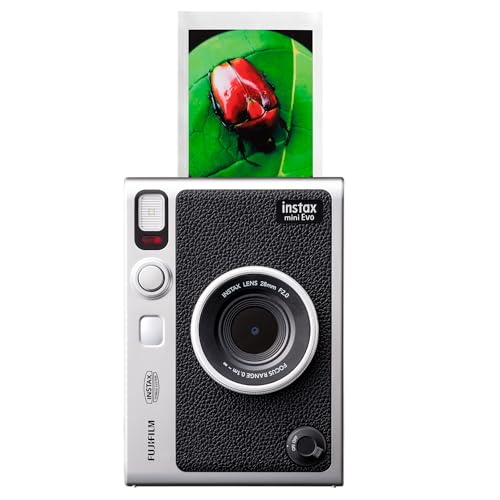
Fujifilm instax mini Evo
A 3 inch screen, a hundred lens-and-film effect combinations, and real instax mini film — the hybrid that gets the balance right.
- Buy it for
- Someone who likes taking photographs and hates wasting film. Also the best hybrid gift for a teenager or a student.
- Skip it if
- A cost-conscious buyer. The film is about 85 cents a shot, which is twice what the Kodak models cost to feed.
- **A 3.0 inch, 460,000-dot LCD** on the back, so you frame, review and choose before a sheet is spent.
- **10 lens effects x 10 film effects = 100 combinations**, selected with two physical dials rather than a menu.
- **About 45 photos of internal storage plus a microSD slot**, so the shots you do not print are not lost.
- **It is also a phone printer** over Bluetooth, with remote shooting from the app — two devices in one body.
- **About 100 prints a charge** from the built-in battery, and a 285 g body that is the lightest hybrid here.
Running cost: instax mini works out at $0.85 a shot. See every format’s cost.
How it scores8.7/10 overall
- Print control10
- Picture quality8
- Running cost5
- Portability9
- Value to buy8
Our editorial scoring, built from published specifications and reviews by outlets that test hardware — see how we pick. We have not handled these products, so these are not test results.
Engadget, which publishes hands-on reviews, calls it “marries the vintage charm of instant photography with digital shooting”.
$234.95 · 15% off · price as of November 28, 2026
#ad · we earn a commission at no extra cost to you
2. Budget pick — cheapest hybrid to buy and to run
Kodak Mini Shot 2 Retro
Camera and phone printer in one body on the cheapest media we have costed: about 42 cents a print, laminated and dry.
- Buy it for
- Anyone who wants the hybrid idea without the instax film bill, and anyone buying a first camera for a child.
- Skip it if
- Someone who wants the instant-film look. These are laminated paper prints, not developing film, and the 1.7 inch screen is small.
- **About 42 cents a print** from a $24.99 cartridge of 60 sheets — half the cost of instax mini film.
- **4PASS dye sublimation with a laminate pass** at 291 x 300 dpi, so prints are sealed, dry and smudge-proof.
- **A 13MP sensor with a 1.7 inch LCD viewfinder**, autofocus from 30 cm and ISO 100 to 1600.
- **It doubles as a phone printer** over Bluetooth and USB-C, with a Lightning adapter in the box.
- **Kodak publishes no prints-per-charge figure** for it, so we do not quote one. The body is 255 g.
Running cost: Kodak 4PASS 2.1 x 3.4 works out at $0.42 a shot, so a hundred photographs in the first year puts the real total at about $179.97 including the camera. See every format’s cost.
How it scores8.1/10 overall
- Print control7
- Picture quality7
- Running cost9
- Portability9
- Value to buy9
Our editorial scoring, built from published specifications and reviews by outlets that test hardware — see how we pick. We have not handled these products, so these are not test results.
price as of November 28, 2026
#ad · we earn a commission at no extra cost to you
3. Best hybrid for square prints
Kodak Mini Shot 3 Retro
The Mini Shot idea on a 3 x 3 inch square, still at about 42 cents a print — against $1.15 a shot for square instant film.
- Buy it for
- Scrapbookers and journal keepers who want the square shape and cannot justify instax SQUARE film prices.
- Skip it if
- Someone who wants the white Polaroid-style border, or detailed specifications: Kodak publishes very little about this model.
- **A 3 x 3 inch square print for about 42 cents**, from the same $24.99 60-sheet 4PASS economics.
- **Camera and Bluetooth phone printer in one**, so household phone photos go through the same machine.
- **4PASS dye sublimation with a laminate pass**, the same sealed finish as the Mini Shot 2.
- **Square prints fit square album pockets** without trimming, which instax SQUARE film does not always do.
- **Kodak's published specification is thin** — no prints-per-charge, no charging time, no sensor detail — and we will not fill those gaps with estimates.
Running cost: Kodak 4PASS 3 x 3 works out at $0.42 a shot, so a hundred photographs in the first year puts the real total at about $199.97 including the camera. See every format’s cost.
How it scores7.8/10 overall
- Print control7
- Picture quality7
- Running cost9
- Portability8
- Value to buy8
Our editorial scoring, built from published specifications and reviews by outlets that test hardware — see how we pick. We have not handled these products, so these are not test results.
$134.99 · 15% off · price as of November 28, 2026
#ad · we earn a commission at no extra cost to you
4. Best hybrid for big prints
Fujifilm instax WIDE Evo
The mini Evo idea on the 3.9 x 2.4 inch WIDE print, with the widest lens instax has made. Also the most expensive instax you can buy.
- Buy it for
- Someone who wants group shots and landscapes on a print big enough to see, and who will pay for it.
- Skip it if
- Almost anyone on a budget — Tech Advisor's own verdict is that the price tag is one most people will find hard to justify.
- **A 16 mm equivalent F2.4 lens**, the widest angle instax has put in a camera, which is what makes the group shots work.
- **A 3.5 inch screen** and 10 lens x 10 film effects plus 6 film styles, so you choose everything before a frame is spent.
- **1600 x 1260 dot prints (635 x 318 dpi)** on instax WIDE film at about $1.10 a shot — dearer per shot than mini, cheaper per square inch.
- **Face-detection autofocus from 10 cm and a 1/4 to 1/8000 sec shutter**, which is a genuinely capable camera rather than a toy.
- **TechRadar calls it one of the most stylish instant hybrids they had seen**, and Tech Advisor calls the price hard to justify. Both are fair.
Running cost: instax WIDE works out at $1.10 a shot, so a hundred photographs in the first year puts the real total at about $519.90 including the camera. See every format’s cost.
How it scores7.7/10 overall
- Print control10
- Picture quality9
- Running cost5
- Portability6
- Value to buy5
Our editorial scoring, built from published specifications and reviews by outlets that test hardware — see how we pick. We have not handled these products, so these are not test results.
Tech Advisor, which publishes hands-on reviews, calls it “this camera-printer hybrid has a high price tag that most people will find hard to justify”.
TechRadar, which publishes hands-on reviews, calls it “one of the most stylish instant hybrid cameras I've ever seen”.
$409.95 · 12% off · price as of November 28, 2026
#ad · we earn a commission at no extra cost to you
| Fujifilm instax mini Evo | Kodak Mini Shot 2 Retro | Kodak Mini Shot 3 Retro | Fujifilm instax WIDE Evo | |
|---|---|---|---|---|
| Film or media | instax mini | Kodak 4PASS 2.1 x 3.4 | Kodak 4PASS 3 x 3 | instax WIDE |
| Print size | 2.4 x 1.8 in (62 x 46 mm) | 2.1 x 3.4 in | 3 x 3 in | 3.9 x 2.4 in (99 x 62 mm) |
| Cost per shot | $0.85 | $0.42 | $0.42 | $1.10 |
| Shots per pack | 20 per $16.99 pack | 60 per $24.99 pack | 60 per $24.99 pack | 20 per $21.99 pack |
| Rough first-year cost | Hardware price not published | $179.97 at 100 shots | $199.97 at 100 shots | $519.90 at 100 shots |
| Power | Built-in rechargeable battery | Rechargeable | Rechargeable | Built-in rechargeable battery |
| Prints from a phone? | Yes | Yes | Yes | Yes |
| Flash | Not published | On, off or auto | Not published | Auto / forced / suppressed; effective approx. 30 cm to 1.5 m |
| Selfie mirror | No | No | No | No |
| Easy for a beginner? | Easy, with a menu to explore | Very easy — effectively one button | Very easy — effectively one button | Easy, with a menu to explore |
| Best for | Shoots digitally, shows you the shot on a screen, and only prints the ones you choose. The single biggest film-cost saver in the category. | Camera and phone printer in one body, on the cheapest print media we verified. You see the shot on a small screen before you spend a sheet. | The square-print version of the Mini Shot. A 3 x 3 in print for about 42 cents, which undercuts square instant film by a wide margin. | The mini Evo idea on the big WIDE print: shoot digitally, choose on a 3.5 inch screen, print only what you want. The widest lens instax has made, and the most expensive instax you can buy. |
| Price | $199.20 · View on Amazon | $112.30 · View on Amazon | $114.74 · View on Amazon | $360.00 · View on Amazon |
Prices as of November 28, 2026 and may change.
What a hybrid costs to feed
| Format | Print size | Pack | Pack price | Cost per shot | Checked at |
|---|---|---|---|---|---|
| Kodak 4PASS 2.1 x 3.4 | 2.1 x 3.4 in | 60 | $24.99 | $0.42 | Kodak Photo Printer store |
| Kodak 4PASS 3 x 3 | 3 x 3 in | 60 | $24.99 | $0.42 | Kodak Photo Printer store |
| instax mini | 2.4 x 1.8 in (62 x 46 mm) | 20 | $16.99 | $0.85 | Pro Photo Supply |
| instax WIDE | 3.9 x 2.4 in (99 x 62 mm) | 20 | $21.99 | $1.10 | Pro Photo Supply |
Where hybrids fall short
- They cost more to buy. Every hybrid here is dearer than a simple instax mini body, and two of them cost more than twice as much. The saving arrives later, in film you did not waste.
- They need charging. Every one runs on a built-in rechargeable battery, so a flat hybrid is a brick — unlike an AA-powered instax, which a supermarket can rescue.
- The magic of not knowing is gone. Some people buy instant cameras precisely because the result is a surprise. A screen removes that, and that is a real loss rather than a quibble.
- They are slower in company. Shoot, review, choose, print is four steps, and at a party the camera stalls while someone scrolls. A one-button instax keeps moving.
- Kodak's published specifications are thin on both Mini Shot models — no prints-per-charge, no charge time — so some questions we simply cannot answer from the manufacturer's own data.
Which hybrid to buy
Buy the instax mini Evo if you want the best hybrid and the instant-film object, and you accept 85 cents a print. Buy the Kodak Mini Shot 2 Retro if the running cost is what matters — it is the cheapest hybrid to buy and the cheapest to feed, and it is the right choice for a child's first camera. Buy the Mini Shot 3 Retro for the same economics in a square, and the instax WIDE Evo only if big prints are the whole point and the price is not an obstacle. If the Evo is the camera you want but not at the price it asks, instax mini Evo alternatives sets the cheaper hybrids, the dial-driven mini 99 and the printer-only route side by side, and the best instant cameras under $150 is where both Kodak bodies land on price.
Questions people ask
What is a hybrid instant camera?
A camera that shoots to a digital sensor, shows you the photo on a screen, and prints only the frames you choose. It still makes a physical print, but nothing is printed by accident — which on film costing 42 to 85 cents a sheet is where the money is saved.
What is the best hybrid instant camera?
The Fujifilm instax mini Evo for most people: a 3 inch screen, 100 lens-and-film effect combinations, about 100 prints a charge, and real instax mini film. The Kodak Mini Shot 2 Retro is the budget pick and prints for about half as much per sheet.
Are hybrid instant cameras worth it?
If the camera will be used regularly, yes — the film you stop wasting outruns the extra hardware cost inside a year of ordinary use. If it will be used twice and then live in a drawer, a simple instax mini body is the better buy.
Do hybrid instant cameras print on real instant film?
Some do. The instax mini Evo and instax WIDE Evo print on genuine instax film. The Kodak Mini Shot 2 and 3 Retro print on 4PASS dye-sublimation paper instead — cheaper and sealed, but not developing film and without the chemical border.
Can a hybrid instant camera print photos from my phone?
All four here can. The instax Evo models and both Kodak Mini Shots accept phone photos over Bluetooth, and the Kodaks also take a USB-C connection. That makes a hybrid a camera and a pocket photo printer in one body.
Which hybrid instant camera is cheapest to run?
Both Kodak Mini Shot models, at about 42 cents a print from a $24.99 cartridge of 60 sheets. The instax mini Evo is about 85 cents a shot and the instax WIDE Evo about $1.10.
Read these next
instax mini Evo review
The full write-up of the top pick here.
Kodak Mini Shot 2 Retro review
The budget pick, in detail.
Instant cameras that print from your phone
Every camera that doubles as a phone printer.
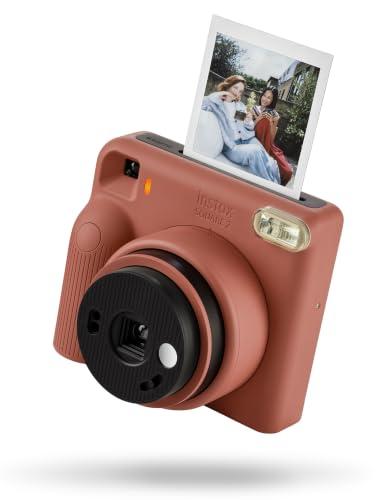
The best instant cameras under $200
Where two of these hybrids sit in the budget ladder.
Sources
- Fujifilm instax mini Evo specifications — 3.0 in LCD, 28 mm equivalent F2.0 lens, 10 lens effects x 10 film effects, about 45 images of internal storage plus microSD, 16 second print time, Bluetooth 4.2 phone printing, about 100 prints a charge, 285 g
- instax — WIDE Evo specifications — Manufacturer specification page, fetched 27 October 2026: 3.5 in LCD, 16 mm equivalent F2.4 lens (the widest angle in instax), single and face-detection AF from 10 cm, shutter 1/4 to 1/8000 sec, ISO 100-1600, 10 lens effects x 10 film effects plus 6 film styles, 1600 x 1260 dot print, Bluetooth 5.1, about 100 prints a charge, 490 g
- Kodak — Mini Shot 2 Retro product page — 4PASS dye sublimation with a laminate pass at 291 x 300 dpi, 2.1 x 3.4 in prints, 13MP sensor with a 1.7 in LCD, 25.4 mm lens, ISO 100-1600, autofocus from 30 cm, Bluetooth and USB-C phone printing, 255 g
- Kodak Photo Printer store — Range and listed-price reference for the Mini 3 Retro, Mini Shot 3 Retro and Dock Plus Retro, read 10 November 2026. Kodak publishes no prints-per-charge or charging-time figure for these three, which is why none is quoted
- Kodak — cartridge collection — 4PASS media pricing read 13 October 2026: 60 sheets of 2.1 x 3.4 in or 3 x 3 in for $24.99, 80 sheets of 4 x 6 in for $31.99 — the basis of the 42-cent and 40-cent per-print figures
- Pro Photo Supply — instax mini film twin pack — $16.99 for 20 exposures on 13 October 2026 — the basis of the 85-cents-a-shot figure
- Pro Photo Supply — instax WIDE film — $21.99 for 20 exposures on 13 October 2026 — the basis of the $1.10-a-shot figure
- Pro Photo Supply — instax SQUARE film, 2 pack — $22.99 for 20 exposures on 13 October 2026 — the basis of the $1.15-a-shot figure
- Engadget — the best instant cameras — Third-party hands-on judgments quoted on this site rather than made by us. Engadget calls the mini Evo a camera that marries the vintage charm of instant photography with digital shooting, the mini 99 one that offers far more control and features, the mini 12 a basic instant camera ideal for newbies, and the SQ40 a camera that looks great thanks to the leatherette details and retro design
- TechRadar — Fujifilm instax WIDE Evo review — Hands-on review; TechRadar calls it one of the most stylish instant hybrid cameras the reviewer had seen
- Tech Advisor — instax WIDE Evo review — Hands-on review; Tech Advisor's verdict is that this camera-printer hybrid has a high price tag that most people will find hard to justify
Found something out of date or wrong? Tell us and we will correct it with a dated note. Our picks are re-checked quarterly — see our editorial policy.