How long does instant film last?
Film is the expensive half of this hobby, so it is worth knowing that it has a shelf life, what shortens it, and what actually happens when you shoot a pack past its date.
Polaroid states its film should be used within 12 months of the production date stamped on the pack, and Fujifilm instructs you to use instax film before the expiration date printed on the box. Polaroid recommends storing sealed packs flat in a fridge at a constant 4-18 C (41-65 F), never frozen, and letting film reach room temperature for at least an hour before shooting.

How this page is funded. Shake & Print earns a commission when you buy through our links, at no extra cost to you. It does not change which products we pick or the order we rank them in, and we do not state prices we have not verified — the buy buttons send you to the current listing instead. Full disclosure.
What the manufacturers actually say
Polaroid is the more specific of the two. Its support documentation states that film should be used within 12 months of the production date, which is stamped on the bottom of each pack, and that the expiry date marks the point beyond which the film is unlikely to meet Polaroid's own quality standards — while noting that correctly stored film may still produce acceptable results for some time afterwards.
Fujifilm's instruction, printed in the user guides for its instax cameras, is simpler: use the film before the expiration or "use before" date on the packaging, keep it in a cool place, never leave it somewhere like a closed car, let film that has been very hot or very cold return to a normal temperature before shooting, and use a pack that has been loaded into a camera as soon as possible.
How to store film properly
- Keep it sealed until you need it. The foil wrapper is doing real work. Unwrapped packs age faster.
- Cool and dark, not frozen. Polaroid recommends a fridge at a constant 4-18 C (41-65 F), stored flat. Both companies warn against heat specifically — a closed car is the worst place film can be.
- Flat, not on edge. Polaroid specifies flat storage; the developer pouch runs along one edge of each sheet and does not benefit from being stood up for months.
- Let it warm up before shooting. Polaroid asks for at least an hour back at ambient temperature; Fujifilm says to let film accustom itself to normal temperature. Cold film develops unevenly and prints blue.
- Keep it out of checked luggage. Fujifilm's guides warn that strong X-ray exposure, including airport baggage inspection, can fog unused film. Carry it in a bag you keep with you.
What expired film actually does
It does not stop working on a date. What happens is gradual: the developer paste thickens and spreads less evenly, the dye layers lose sensitivity at different rates, and prints come back with colour casts — often blue, sometimes pink or yellow — with lower contrast and occasional patches where the paste did not reach.
Some photographers like that look and shoot expired film deliberately. That is a legitimate choice. It is not a legitimate choice for a wedding, a birthday or any occasion where the photographs cannot be retaken, and it is a terrible choice for a gift, because the recipient will conclude the camera is faulty.
Why this matters more for Polaroid than for instax
| Format | Print size | Pack | Pack price | Cost per shot | Checked at |
|---|---|---|---|---|---|
| Kodak 4PASS 2.1 x 3.4 | 2.1 x 3.4 in | 60 | $24.99 | $0.42 | Kodak Photo Printer store |
| instax mini | 2.4 x 1.8 in (62 x 46 mm) | 20 | $16.99 | $0.85 | Pro Photo Supply |
| Polaroid Go | 2.6 x 2.1 in (66.6 x 53.9 mm) | 16 | $21.99 | $1.37 | Polaroid |
| Polaroid i-Type | 4.2 x 3.5 in (107 x 88 mm) | 8 | $18.99 | $2.37 | Polaroid |
The arithmetic is unforgiving. A wasted 20-exposure pack of instax mini is about $17. A wasted 8-photo pack of Polaroid i-Type is about $19 for less than half as many photographs — so per lost photograph, Polaroid film spoiling costs nearly three times as much. That is the practical reason to buy Polaroid film in smaller quantities and closer to when you will use it.
How much to buy, given all this
- For a gift: two packs. Enough to be usable immediately, not enough to sit around ageing.
- For regular use: buy as you go. Multipacks are cheaper per shot, which matters, but only if the film gets shot within the year.
- For an event: order to the guest count and order early, because instax SQUARE and WIDE are not supermarket stock. Our wedding film page does the arithmetic.
- For a stockpile: choose printer media instead. A 4PASS or ZINK pack has no developer chemistry in it, so there is nothing to go off.
Three products that illustrate the trade-off

1. Easiest film to buy fresh
Fujifilm instax mini 12
instax mini turns over fastest, so the pack on the shelf is usually a recent one.
- Buy it for
- Anyone who would rather not think about film dates at all.
- Skip it if
- Someone who wants the big Polaroid print — this is the small format.
- instax mini is stocked by supermarkets and pharmacies as well as camera shops, so stock rotates quickly.
- 20 exposures for $16.99 means a pack gets used before it has time to age.
- Fujifilm's own instruction is simply to use film before the date on the box — there is no fridge regime to follow.
Running cost: instax mini works out at $0.85 a shot. See every format’s cost.
How it scores9.0/10 overall
- Buying fresh10
- Cost per shot9
- Pack size suits one event8
Our editorial scoring, built from published specifications and reviews by outlets that test hardware — see how we pick. We have not handled these products, so these are not test results.
Engadget, which publishes hands-on reviews, calls it “a basic instant camera ideal for newbies that lets you get started shooting”.
#ad · we earn a commission at no extra cost to you
2. The film that needs the most care
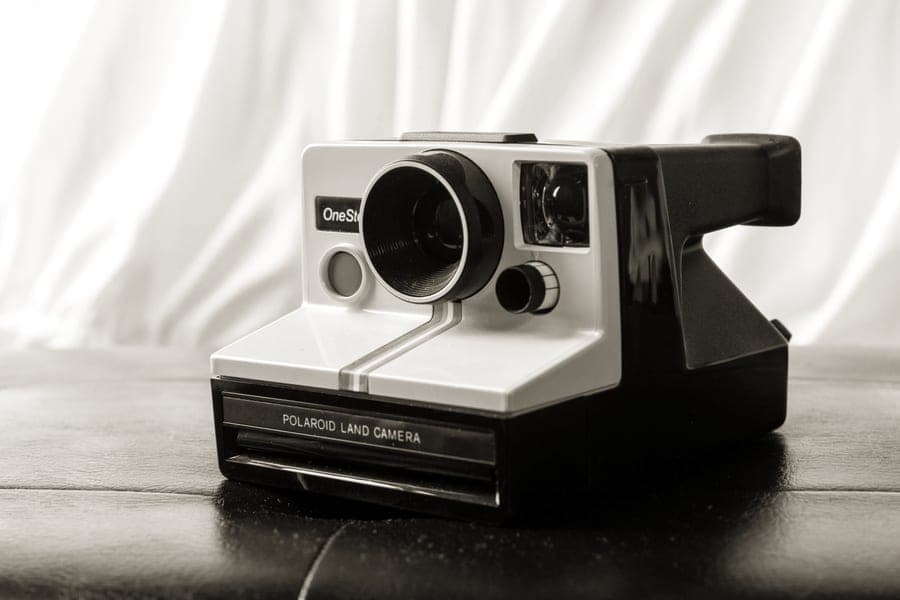
Polaroid Now Generation 3
Polaroid film is the most sensitive to heat and age of anything here.
- Buy it for
- Polaroid owners, who should read the storage section below rather than skim it.
- Skip it if
- A buyer who wants to stockpile film cheaply. Polaroid stock does not reward hoarding.
- Polaroid's guidance is to use film within 12 months of the production date stamped on the pack.
- At about $2.37 a shot for i-Type, a spoiled pack of 8 is roughly $19 of waste.
- Polaroid recommends fridge storage at a constant 4-18 C, flat, in the sealed packaging.
Running cost: Polaroid i-Type works out at $2.37 a shot, so a hundred photographs in the first year puts the real total at about $366.86 including the camera. See every format’s cost.
How it scores6.6/10 overall
- Buying fresh7
- Cost per shot3
- Pack size suits one event4
Our editorial scoring, built from published specifications and reviews by outlets that test hardware — see how we pick. We have not handled these products, so these are not test results.
#ad · we earn a commission at no extra cost to you
3. The option with no shelf-life problem
Kodak Mini 2 Retro
Printer cartridges are paper and ribbon, not chemistry — they do not expire usefully.
- Buy it for
- Anyone who prints occasionally and hates the idea of consumables going off.
- Skip it if
- Someone who wants real instant film with its white frame and development.
- 4PASS cartridges are paper plus a dye ribbon, with no developer paste to degrade.
- About 42 cents a print, so stocking up is cheap and carries no spoilage risk.
- A printer left in a drawer for a year still works, which is not true of an inkjet or a loaded film camera.
Running cost: Kodak 4PASS 2.1 x 3.4 works out at $0.42 a shot, so a hundred photographs in the first year puts the real total at about $139.97 including the camera. See every format’s cost.
How it scores9.2/10 overall
- Buying fresh10
- Cost per shot10
- Pack size suits one event9
Our editorial scoring, built from published specifications and reviews by outlets that test hardware — see how we pick. We have not handled these products, so these are not test results.
#ad · we earn a commission at no extra cost to you
And how long do the photographs last?
That is a different question, and the honest answer is: longer than people expect, if you keep them out of sunlight. Instant prints fade in direct light — which is why Polaroid sells UV-glazed frames — and the dyes are more fragile than a laboratory print. Kept in an album or behind UV glass, a modern instant print is a decades-long object. Taped to a sunny window, it will visibly fade within a year. We cover the practical side on how to store instant photos.
Questions people ask
How long does instant film last?
Polaroid says its film should be used within 12 months of the production date stamped on the pack, and Fujifilm instructs users to shoot instax film before the expiration date printed on the box. Correctly stored film may still work after that, with reduced colour accuracy and contrast.
How should I store instant film?
Sealed, cool and flat. Polaroid recommends a fridge at a constant 4-18 C (41-65 F) and warns against freezing; Fujifilm says to keep instax film in a cool place and never leave it somewhere like a closed car. Let film return to room temperature for at least an hour before shooting.
Can you use expired instant film?
Usually yes, with unpredictable results — colour casts, lower contrast and uneven development. It is fine for experimenting and wrong for an occasion you cannot reshoot, and it is a poor idea in a gift, because the recipient will think the camera is broken.
Does a loaded film pack go off faster?
Yes. Once a pack is in the camera the sheets are out of their foil wrapper, and both manufacturers instruct you to use a loaded pack as soon as possible. A half-used pack left in a camera for months is the most common cause of patchy prints.
Read these next
Where to buy instant film
Which formats are on a shelf locally and which are order-ahead.

How much film do I need?
Working out the right quantity before you buy.

How to store instant photos
Keeping the prints as carefully as the film.

The cheapest instant film
Every format ranked by cost per shot.
Sources
- Polaroid support — How should I store Polaroid film? — Polaroid's own guidance: store sealed packs flat in a fridge at a constant 4-18 C / 41-65 F, never freeze, and allow at least 1 hour to return to ambient temperature before shooting
- Polaroid support — What is the date stamped on the film box? — Polaroid states film should be used within 12 months of the production date stamped on the pack for best results
- Fujifilm instax WIDE 400 user's guide (PDF) — Fujifilm's own film handling instructions: keep film cool, never leave it in a closed car, let film reach normal temperature before shooting, use before the expiration date, and use a loaded pack as soon as possible
- Pro Photo Supply — instax mini film, 20 exposures — $16.99 on 13 October 2026, the basis of the 85c-per-shot figure
- Polaroid — Color i-Type film — $18.99 for 8 photos, image area 79 x 77 mm, ASA 640
- Kodak — 4PASS cartridges — $24.99 for 60 prints (2.1x3.4 and 3x3), $31.99 for 80 prints (4x6), 13 October 2026
- Polaroid — all instant film — Current film range and pack prices, 17 October 2026
Found something out of date or wrong? Tell us and we will correct it with a dated note. Our picks are re-checked quarterly — see our editorial policy.