Polaroid Now Generation 3 review
This is the camera people mean when they say Polaroid. The photograph is the best reason to buy it and the film cost is the reason to think first.
The Polaroid Now Generation 3 makes the classic 4.2 x 3.5 inch Polaroid print and adds a twin-lens autofocus system with two zones. It was $119.99 at launch. Its i-Type film is about $2.37 a shot — a hundred photographs costs roughly $237, about twice the camera.

How this page is funded. Shake & Print earns a commission when you buy through our links, at no extra cost to you. It does not change which products we pick or the order we rank them in, and we do not state prices we have not verified — the buy buttons send you to the current listing instead. Full disclosure.
1. Verdict: the Polaroid worth buying
Polaroid Now Generation 3
The iconic print, with autofocus that picks the right lens — and a film bill to match.
- Buy it for
- Anyone who wants the classic Polaroid photograph and has seen the per-shot figure.
- Skip it if
- Volume shooting, a tight budget, or a pocket. $2.37 a shot, eight exposures a pack, and 448 g.
- A **4.2 x 3.5 inch** print with a 79 x 77 mm image area — the photograph everyone pictures.
- **Two-lens autofocus** with zones at 0.40-1.3 m and 1.0 m to infinity, against fixed focus on the Go.
- Six usable apertures from f/11 to f/64, and a 40 x 41 degree field of view.
- A built-in tripod mount, filter compatibility, self-timer and double exposure.
- Takes **both i-Type and older 600 film**, so vintage packs are not wasted. USB-C charging, 40% recycled materials.
Running cost: Polaroid i-Type works out at $2.37 a shot, so a hundred photographs in the first year puts the real total at about $366.86 including the camera. See every format’s cost.
How it scores7.9/10 overall
- Print size10
- Focus accuracy8
- Build and feel9
- Ease of use8
- Running cost2
Our editorial scoring, built from published specifications and reviews by outlets that test hardware — see how we pick. We have not handled these products, so these are not test results.
#ad · we earn a commission at no extra cost to you
What it is
The Now is Polaroid's mainstream camera: the full-size print, in a body designed to be used rather than collected. Generation 3, launched in March 2025, is the version worth buying, and the reason is focus.
Instant film has no latitude and no second chance, so a soft photograph at $2.37 a frame is an expensive disappointment. The Gen 3's twin-lens system selects between two lenses depending on subject distance, with zones at 0.40 to 1.3 meters and 1.0 meter to infinity. Polaroid also repositioned the light meter and improved the ranging sensor for this generation.
Specifications
| Film | Polaroid i-Type and Polaroid 600 (sold separately) |
|---|---|
| Print size | 4.2 x 3.5 in (107 x 88 mm) |
| Image area | 79 x 77 mm (3.1 x 3.0 in) |
| Film ASA | 640 (i-Type and 600) |
| Development time | 10 to 15 minutes |
| Autofocus | Two-lens system, 2 fixed zones: 0.40-1.3 m and 1.0 m to infinity |
| Apertures | Six usable, f/11 to f/64 |
| Field of view | Horizontal 40 degrees, vertical 41 degrees |
| Modes | Self-timer and double exposure |
| Extras | Built-in tripod mount, filter compatible, 40% recycled materials |
| Power | Rechargeable via USB-C |
| Dimensions | 150.2 x 112.2 x 94 mm (5.91 x 4.42 x 3.7 in) |
| Weight | 448 g (15.8 oz) |
| Launch price | $119.99 MSRP, March 2025 |
What it costs to own
This is the part to be clear-eyed about. Polaroid i-Type film was $18.99 for eight photographs on 13 October 2026 — about $2.37 a shot, the most expensive mainstream instant film sold.
| Format | Print size | Pack | Pack price | Cost per shot | Checked at |
|---|---|---|---|---|---|
| instax mini | 2.4 x 1.8 in (62 x 46 mm) | 20 | $16.99 | $0.85 | Pro Photo Supply |
| instax SQUARE | 2.4 x 2.4 in (62 x 62 mm image on 86 x 72 mm film) | 20 | $22.99 | $1.15 | Pro Photo Supply |
| Polaroid Go | 2.6 x 2.1 in (66.6 x 53.9 mm) | 16 | $21.99 | $1.37 | Polaroid |
| Polaroid i-Type | 4.2 x 3.5 in (107 x 88 mm) | 8 | $18.99 | $2.37 | Polaroid |
| Polaroid 600 | 4.2 x 3.5 in (107 x 88 mm) | 8 | $20.99 | $2.62 | Polaroid |
| Camera or printer | 40 shots | 100 shots | 200 shots |
|---|---|---|---|
| Polaroid Now Generation 3$119.99 MSRP at launch, March 2025 | $214.945 packs of Polaroid i-Type | $366.8613 packs of Polaroid i-Type | $594.7425 packs of Polaroid i-Type |
| Fujifilm instax SQUARE SQ40Hardware price not published — film cost only | $45.982 packs of instax SQUARE | $114.955 packs of instax SQUARE | $229.9010 packs of instax SQUARE |
| Fujifilm instax mini 12Hardware price not published — film cost only | $33.982 packs of instax mini | $84.955 packs of instax mini | $169.9010 packs of instax mini |
At a hundred photographs a year, the film costs about $237 — roughly twice the camera. At two hundred, about $475. Multipacks take some of the edge off: Polaroid's own five-pack works out at about $2.12 a shot rather than $2.37, an 11% saving.
None of that is an argument against the camera. It is the number to decide with rather than discover. There is more in why Polaroid film is so expensive.
What it is good at
- The photograph. A 4.2 x 3.5 inch print is an object: it frames, it goes on a shelf, it reads as a photograph rather than a token. Nothing in the instax range matches it.
- Autofocus that works. Two zones chosen automatically is a real advantage over fixed focus on film this expensive.
- Flexibility of film. Taking both i-Type and 600 means old stock and new both work.
- A tripod mount and a self-timer, which together make group shots and long exposures practical.
- Build. 448 g of substantial camera, with filter compatibility and 40% recycled materials.
Where it falls short
- $2.37 a shot. The dominant drawback and the one that decides most purchases. Eight exposures a pack means a pack is gone in an afternoon.
- Development takes 10 to 15 minutes, against 90 seconds for instax, and the print needs shielding from light while it happens. At a party that is a practical nuisance.
- It is big. 150 x 112 x 94 mm and 448 g — a bag camera, not a pocket one.
- No published battery life. Polaroid gives a figure for the Go and not for this, which is an odd omission on a rechargeable camera.
- Film is harder to buy. Mostly online or a camera shop, where instax mini is in supermarkets.
- Two fixed focus zones, not continuous autofocus. Better than fixed focus, short of what the specification implies at first glance.
Alternatives
| Polaroid Now Generation 3 | Polaroid Flip | Polaroid Go Generation 3 | Fujifilm instax SQUARE SQ40 | |
|---|---|---|---|---|
| Film or media | Polaroid i-Type | Polaroid i-Type | Polaroid Go | instax SQUARE |
| Print size | 4.2 x 3.5 in (107 x 88 mm) | 4.2 x 3.5 in (107 x 88 mm) | 2.6 x 2.1 in (66.6 x 53.9 mm) | 2.4 x 2.4 in (62 x 62 mm image on 86 x 72 mm film) |
| Cost per shot | $2.37 | $2.37 | $1.37 | $1.15 |
| Shots per pack | 8 per $18.99 pack | 8 per $18.99 pack | 16 per $21.99 pack | 20 per $22.99 pack |
| Rough first-year cost | $366.86 at 100 shots | $466.86 at 100 shots | $243.92 at 100 shots | Hardware price not published |
| Power | Rechargeable, USB-C | Rechargeable, USB-C | Built-in rechargeable battery | Two CR2 lithium batteries |
| Prints from a phone? | No | No | No | No |
| Flash | Not published | Polaroid's most powerful flash to date | Vacuum discharge tube flash | Constant firing, automatic; effective 0.3-2.2 m |
| Selfie mirror | No | No | Yes | Yes |
| Easy for a beginner? | Moderate — there are dials to learn | Very easy — effectively one button | Moderate — there are dials to learn | Very easy — effectively one button |
| Best for | The full-size Polaroid, with a twin-lens autofocus system that picks the right lens for the shot. The classic big white-bordered print. | Polaroid's most capable modern camera, with sonar autofocus and a warning when the shot is going to be over- or under-exposed. Priced accordingly. | A real Polaroid, shrunk. The white-framed square print is unmistakable and the camera genuinely fits in a coat pocket. | The square frame people mean when they say 'Polaroid', on film that costs half as much. Leatherette body, one button, nothing to learn. |
- Polaroid Flip, $219.99 listed — sonar autofocus, a four-lens system, Polaroid's most powerful flash, and a warning before a badly exposed frame. Engadget calls it the "most advanced modern instant camera to date". Same film cost. See best Polaroid cameras.
- [Polaroid Go Generation 3](/instant-cameras/polaroid-go-gen-3-review) — $30 cheaper and cheaper to run, with a much smaller print.
- [instax SQUARE SQ40](/instant-cameras/instax-square-sq40-review) — a square print at $1.15 a shot rather than $2.37. Not a Polaroid, and less than half the running cost.
- Polaroid Mod, $169.99 listed — a newer body on the same i-Type film. Worth comparing directly at the time you buy.
Who should buy it
Buy the Now Generation 3 if the classic Polaroid photograph is what you want. It is the sensible point in the range: the full print, genuine autofocus, a tripod mount and a self-timer, without the Flip's premium.
Do not buy it for someone who will shoot a lot, or for a child, or as a general-purpose gift for someone undecided. At $2.37 a frame it rewards deliberate photography and punishes casual snapping — which is a fair description of what Polaroid has always been.
Questions people ask
Is the Polaroid Now Generation 3 worth it?
Yes if you want the classic 4.2 x 3.5 inch Polaroid print and have accepted the film cost. The Gen 3's twin-lens autofocus is a real improvement on fixed focus when film costs $2.37 a frame. It is not worth it for volume shooting — a hundred photographs costs roughly $237 in film alone.
How much does Polaroid Now film cost?
Polaroid color i-Type film was $18.99 for eight photographs on 13 October 2026 — about $2.37 each. Buying Polaroid's own five-pack brings it to about $2.12 a shot, an 11% saving. The camera also takes 600 film, which was $20.99 for eight, about $2.62 a shot.
Does the Polaroid Now Generation 3 have autofocus?
Yes — a two-lens system that selects between lenses by subject distance, with fixed zones at 0.40 to 1.3 meters and 1.0 meter to infinity. It is not continuous autofocus, but it is a clear improvement on the fixed-focus Polaroid Go.
What is the difference between the Polaroid Now and the Flip?
The Flip, $219.99 listed, has sonar autofocus with a four-lens system, Polaroid's most powerful flash, and an over- or under-exposure warning before you spend a frame. The Now Generation 3 has two-lens autofocus in two zones at $119.99 MSRP. Both use the same i-Type film at the same cost.
How long does a Polaroid photo take to develop?
Ten to fifteen minutes for i-Type, 600 and SX-70 film, against about 90 seconds for instax. Keep the print face-down and away from bright light while it develops, and do not shake it — shaking does nothing useful and can damage the emulsion.
Read these next

Polaroid Now vs Polaroid Go
The print-size decision, with both cameras' specifications.
Best Polaroid cameras
The full range, including the Flip.
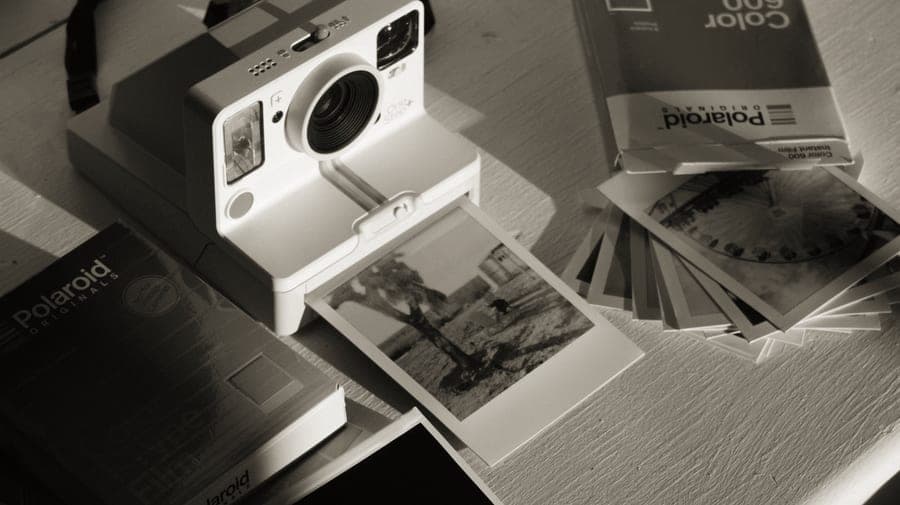
What Polaroid film costs per shot
All four films, with the multipack savings.
Instax vs Polaroid
Whether to buy Polaroid at all.
Albums for instant prints
Full-size Polaroid prints need a 4.2 x 3.5 inch pocket.
Sources
- Polaroid Now Generation 3 specifications (retailer listing) — Polaroid's own Gen 3 page was unreachable; specification from the retailer listing
- Polaroid Now Generation 3 launch announcement — $119.99 launch MSRP, two-lens autofocus, March 2025
- Polaroid — Color i-Type film — $18.99 for 8 photos on 13 October 2026
- Polaroid — instant cameras — Listed prices, 13 October 2026
- Engadget — the best instant cameras — Cited for published verdicts on handling and image quality
Found something out of date or wrong? Tell us and we will correct it with a dated note. Our picks are re-checked quarterly — see our editorial policy.