How to build a DIY photo booth with an instant camera
A rented booth costs more than the camera, the film and the backdrop put together. The catch is that instant-camera flashes are short-range, and almost every failed home booth fails for that one reason.
Put the backdrop about 1.5 m behind your guests and have them stand 1 to 2 m from the camera, because most instax flashes only reach 2.2 m. Mount the camera at chest height, light the faces rather than the backdrop, and budget three to four shots per guest.

How this page is funded. Shake & Print earns a commission when you buy through our links, at no extra cost to you. It does not change which products we pick or the order we rank them in. Prices on the buy buttons come from Amazon and carry the date they were read; where we have no current price the button shows no figure. Full disclosure.
A hired photo booth is one of the more expensive line items at a party, and most of what it does is hold a camera at a fixed distance in front of a lit backdrop. You can build that. The parts cost less than a rental hour: a camera you keep afterwards, a few packs of film, something to hang behind people, and a light.
What goes wrong is almost always the same thing, and it is not the backdrop. Instant-camera flashes are short-range — most of them stop at 2.2 meters — so a booth laid out like a studio produces a row of dark photographs of people standing too far back. Everything below follows from that one number.
What a booth actually needs
Five things, in the order they decide whether it works:
- A distance that matches the camera's flash. This is the whole design constraint. Know your camera's flash range before you place anything.
- Light on the faces, not the backdrop. A lit backdrop with dark faces is the signature of a home booth.
- A fixed camera position. Framing that changes every shot is why half the prints have someone's forehead cut off.
- Enough film, bought before the day. Guests take three to four shots each, not one.
- Somewhere for the prints to go immediately. A pile on a table gets knocked over; a line with clips does not.
Light is the whole problem
Here are the verified flash ranges across our registry. These are manufacturer figures, and they are the numbers that set your booth depth — the far edge of the useful area is the top of the range, and you want guests comfortably inside it rather than at its limit.
| Camera | Flash effective range | What that means for a booth |
|---|---|---|
| instax mini 12 / 13 / 41 | 0.3-2.2 m | A booth about 1.5-2 m deep. The standard case. |
| instax SQUARE SQ40 | 0.3-2.2 m | Same depth, a square frame that holds two faces better. |
| instax SQUARE 2 | 0.3-2.2 m | Same depth; the flash recycles in 7.5 sec or less, which matters in a queue. |
| instax mini 99 | 0.3-2.7 m | Half a meter more depth, plus slow-synchro for the background. |
| instax WIDE 400 | 0.9-3 m | The deepest booth here — but nothing closer than 0.9 m will focus. |
| instax WIDE Evo | approx. 0.3-1.5 m | The shortest reach in the range. A very tight booth only. |
| Polaroid Flip | 4.5 m at f8 | The longest verified reach of any camera we list. |
| Polaroid Now Generation 3 | Not published as a distance | Treat it as a close-range booth and test before the day. |
Two practical readings of that table. If your room is dim and deep, the instax mini 99 and the Polaroid Flip are the two cameras that will cope, and the mini 99 is the one with slow-synchro and a bulb mode as well. If your booth has to be tight — a corner, an alcove, a hallway — almost anything works, and the instax WIDE 400 is the one that will not, because it cannot focus closer than 0.9 m.
Add light anyway. A flash that reaches 2.2 m still produces a better photograph when there is ambient light on the faces: a lamp with the shade off, placed beside and slightly above the camera, is enough and costs nothing. String lights behind the guests look lovely in the room and contribute nothing to the exposure. If the venue is genuinely dark, read the best instant cameras for low light before you choose the camera.
The backdrop
A backdrop does two jobs: it hides the room and it stops the flash falling off into a black void behind your guests. A pale surface about a meter and a half behind people does both. Anything works — a bedsheet pinned flat, a roll of kraft paper, a curtain, a painted wall, a fringe curtain from a party shop.
- Pale beats dark. A light backdrop bounces flash back onto the subject; a black one eats it and makes the photograph look underexposed even when the faces are fine.
- Flat beats draped. Creases read as shadows on a small print. Iron a sheet or tape it taut.
- Keep a gap. About 1.5 m between backdrop and guests stops hard shadows landing on it.
- Avoid anything shiny. Sequins, foil and glossy balloons throw the flash straight back into the lens as a white blob.
- Keep it busy-free. On a 2.4 x 1.8 inch print, a patterned backdrop competes with faces and wins.
Mounting the camera, or deliberately not
You have two real options, and they produce different booths.
Fixed camera. The camera sits in one place, framing is consistent, and nobody has to think. This is the better booth and it needs a tripod mount. The only camera in our registry with a verified built-in tripod mount is the Polaroid Now Generation 3, which also has a self-timer — together those two features make a booth that runs itself. No instax mini in the range has a tripod socket, so a fixed instax booth means a stack of books, a shelf or a table at chest height, with a mark on the floor where guests stand.
Handed-around camera. Simpler, more fun, and the framing is whatever the guest manages. This is what most parties end up doing and it is fine — it just costs more film, because roughly one shot in four is unusable. If this is your booth, buy the camera with the cheapest film and accept the waste rather than trying to prevent it.
Props, signage and the instruction card
Props should be few and large: hats, glasses, a sign or two, something to hold. Small props do not read on a print this size. Keep them in a basket beside the booth rather than on the table where the prints land.
The one piece of paper worth making is an instruction card, and it saves more film than anything else here. Four lines: stand on the mark, press this button once, do not shake it, put the print on the line. Our photo guest book page goes into the wording in detail — the same card works for a booth.
How much film
Guests take three to four photographs each at a booth, not one. That is the number most people get wrong, and running out halfway through is the one failure nobody forgives.
| Guests | Shots to plan for | instax packs | Polaroid packs |
|---|---|---|---|
| 10-15 | 40-50 | 3 packs | 6-7 packs |
| 20-30 | 70-100 | 4-5 packs | 9-13 packs |
| 40-50 | 140-180 | 7-9 packs | 18-23 packs |
| 80-100 | 250-350 | 13-18 packs | 32-44 packs |
The Polaroid column is why a booth on Polaroid film is a luxury rather than a default: 100 guests is a four-figure film bill. The same arithmetic for a wedding specifically is in how much film do you need for a wedding, and the general calculator is how much instant film do I need.
The cameras we would use
Five options, chosen on flash reach, film cost and whether the booth needs an attendant. Every one of them names what it is bad at, because a booth camera with no downside does not exist.
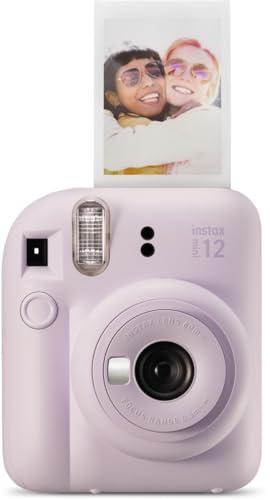
1. Best booth camera for most parties
Fujifilm instax mini 12
Cheap film, 20 shots a pack, nothing to set wrong, and a flash that reaches far enough for a two-meter booth.
- Buy it for
- Any party where the camera will be handed around and nobody will read an instruction card.
- Skip it if
- A booth deeper than about two meters, or a group of more than three people — the frame is small and the flash stops at 2.2 m.
- **Flash effective 0.3-2.2 m**, which sets your whole booth depth and is as good as most of the range.
- **About 85 cents a shot** — the cheapest real instant film, which matters when guests take three each.
- **20 exposures a pack**, so a 40-guest party is six packs rather than twenty.
- **Two AA batteries**, so there is nothing to charge on the day and a spare set costs almost nothing.
- **Close-up mode from 0.3 m** for the inevitable arm's-length selfie attempts.
Running cost: instax mini works out at $0.85 a shot. See every format’s cost.
Engadget, which publishes hands-on reviews, calls it “a basic instant camera ideal for newbies that lets you get started shooting”.
price as of November 28, 2026
#ad · we earn a commission at no extra cost to you
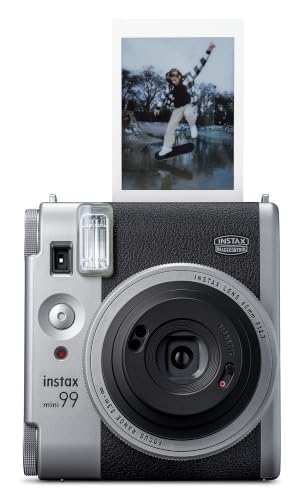
2. Best for a dim room
Fujifilm instax mini 99
The longest flash reach in the instax mini range, plus the only bulb mode — which is the honest answer to a dark venue.
- Buy it for
- An evening event, a dim bar, a marquee after sunset, or any booth you cannot light properly.
- Skip it if
- A booth guests operate unsupervised. It has dials and switches, and a guest will turn one.
- **Flash effective 0.3-2.7 m** — half a meter further than every other instax mini, which is a lot in a booth.
- **Indoor and slow-synchro flash modes**, so the background is not a black rectangle.
- **Shutter 1.8 to 1/400 sec plus bulb up to 10 seconds** for a tripod shot of a dark room.
- **Exposure compensation from -5/3 to +1 EV**, so you can fix a booth that is consistently too dark.
- **Rechargeable**, about 10 film packs a charge — charge it the night before.
Running cost: instax mini works out at $0.85 a shot. See every format’s cost.
Engadget, which publishes hands-on reviews, calls it “offers far more control and features”.
$234.99 · 24% off · price as of November 28, 2026
#ad · we earn a commission at no extra cost to you
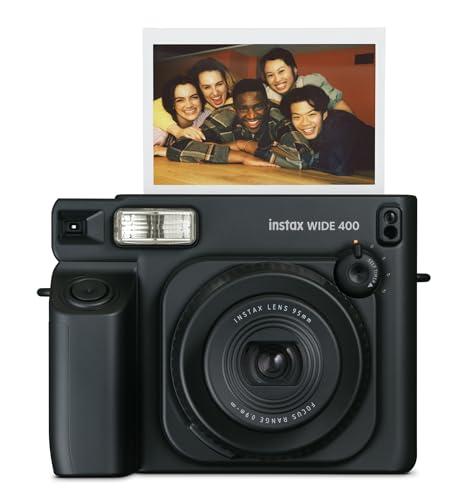
3. Best for groups
Fujifilm instax WIDE 400
The widest instant-film frame, and the only camera here whose flash reaches three meters — at the cost of a 0.9 m minimum distance.
- Buy it for
- Group shots, wedding receptions, anywhere four people want to be in one frame.
- Skip it if
- A tight booth or a close-up. It cannot focus closer than 0.9 m, so a small space will not work.
- **Flash effective 0.9-3 m**, the longest reach of any instax in our registry.
- **The 3.9 x 2.4 inch print**, about twice the area of a mini — a group actually reads on it.
- **20 exposures a pack** at about $1.10 a shot.
- **Four AA batteries** and 616 g, so it sits steadily on a table or a stack of books.
- **Shooting range starts at 0.9 m** — mark that distance on the floor and the booth works.
Running cost: instax WIDE works out at $1.10 a shot. See every format’s cost.
Engadget, which publishes hands-on reviews, calls it “simple operation”.
$175.95 · 15% off · price as of November 28, 2026
#ad · we earn a commission at no extra cost to you
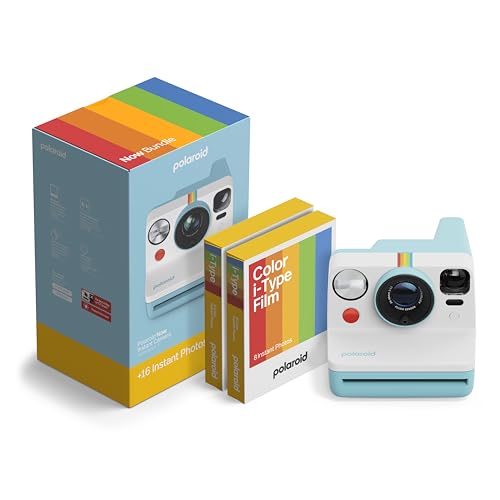
4. Best unmanned booth
Polaroid Now Generation 3
A self-timer and the only verified tripod mount in our registry, which together make a booth nobody has to staff.
- Buy it for
- A booth where guests photograph themselves with no attendant, and anyone who wants the classic white-bordered print.
- Skip it if
- A film budget. Eight shots a pack at about $2.37 each is the most expensive way to run a booth on this page.
- **A built-in tripod mount** — the only one we can verify in the registry, which is what fixes the framing.
- **A self-timer**, so nobody has to press the button for anyone else.
- **Twin-lens autofocus** across zones from 0.40 m to infinity, so the framing tolerance is wide.
- **Double exposure** mode, which guests genuinely enjoy at a booth.
- **Only 8 exposures a pack** at about $2.37 a shot — do the film maths before you commit.
Running cost: Polaroid i-Type works out at $2.37 a shot, so a hundred photographs in the first year puts the real total at about $366.86 including the camera. See every format’s cost.
$159.99 · 25% off · price as of November 28, 2026
#ad · we earn a commission at no extra cost to you
5. Best booth with no camera at all
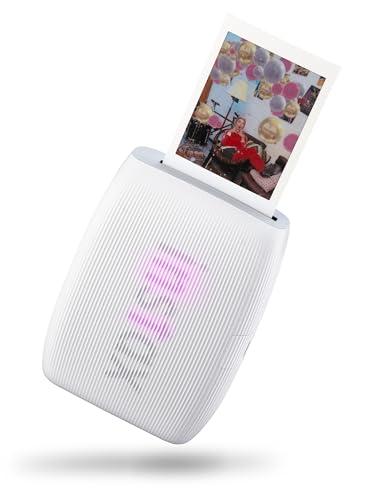
Fujifilm instax mini Link 3
Guests photograph themselves on their own phones and print the one they like — zero wasted film.
- Buy it for
- A tech-comfortable crowd, a long event, or anyone who hated how much film a camera booth burned.
- Skip it if
- A crowd that will not install an app, or a booth that needs to work without someone managing the queue.
- **Nothing is printed until somebody chooses it**, which is the single biggest film saving available.
- **Same instax mini film** at about 85 cents, so the per-print cost is identical to a mini camera.
- **Prints from any phone** over Bluetooth, iOS or Android.
- **No framing problem** — the phone's own camera and screen handle it.
- **It is a queue, not a booth.** One printer, one phone at a time; budget a minute per print.
Running cost: instax mini works out at $0.85 a shot, so a hundred photographs in the first year puts the real total at about $201.94 including the camera. See every format’s cost.
$116.95 · 15% off · price as of November 28, 2026
#ad · we earn a commission at no extra cost to you
| Fujifilm instax mini 12 | Fujifilm instax mini 99 | Fujifilm instax WIDE 400 | Polaroid Now Generation 3 | |
|---|---|---|---|---|
| Film or media | instax mini | instax mini | instax WIDE | Polaroid i-Type |
| Print size | 2.4 x 1.8 in (62 x 46 mm) | 2.4 x 1.8 in (62 x 46 mm) | 3.9 x 2.4 in (99 x 62 mm) | 4.2 x 3.5 in (107 x 88 mm) |
| Cost per shot | $0.85 | $0.85 | $1.10 | $2.37 |
| Shots per pack | 20 per $16.99 pack | 20 per $16.99 pack | 20 per $21.99 pack | 8 per $18.99 pack |
| Rough first-year cost | Hardware price not published | Hardware price not published | Hardware price not published | $366.86 at 100 shots |
| Power | Two AA batteries | Rechargeable battery (NP-70S) | Four AA batteries | Rechargeable, USB-C |
| Prints from a phone? | No | No | No | No |
| Flash | Constant firing, automatic; effective 0.3-2.2 m | Auto with indoor/slow-synchro, fill-in, red-eye reduction; effective 0.3-2.7 m | Built-in automatic; effective 0.9-3 m | Not published |
| Selfie mirror | Yes | No | No | No |
| Easy for a beginner? | Very easy — effectively one button | Moderate — there are dials to learn | Very easy — effectively one button | Moderate — there are dials to learn |
| Best for | The hardest instant camera in the world to get wrong: twist the lens to turn it on, press the button, done. Still the safest gift in the category. | The one for someone who already likes photography: color-effect dial, vignette switch, double exposure, bulb mode, and a rechargeable battery. | The one that fits a whole group in frame. Prints are almost twice the width of a mini, which is why it keeps turning up at weddings. | The full-size Polaroid, with a twin-lens autofocus system that picks the right lens for the shot. The classic big white-bordered print. |
| Price | $79.95 · View on Amazon | $179.00 · View on Amazon | $149.00 · View on Amazon | $119.99 · View on Amazon |
Prices as of November 28, 2026 and may change.
Where the prints go
Decide this before the party, not during it. Prints that land in a heap on the table get drinks spilled on them and go home with the wrong people.
- A line and clips. Twine and wooden pegs, strung beside the booth. Cheap, looks good, and everyone can see the photographs — which is most of the point. Check the clip width: a peg sized for a 4 x 6 print will crease an instax mini border.
- A guest book. If you want the prints to stay together with messages beside them, that is a book rather than a line — the setup is in how to set up a photo guest book.
- An album on the table. Works, but only if someone is slotting prints in as they arrive. Pocket size has to match the format — what size are instant photos has the fit table.
- A tray and an envelope per guest if people are taking their photographs home. Write names on the envelopes beforehand.
- Pens, and the right ones. A fine permanent marker writes on an instax border; a ballpoint dents the print and a gel pen smears.
What goes wrong
- Guests stand too far back. The single most common failure. The flash cannot reach and every print is dark. Tape on the floor fixes it.
- Shiny backdrop. Foil curtains and sequins bounce the flash into the lens. Matte surfaces only.
- Nobody shields the prints. Polaroid film needs shielding from light for its 10-15 minute development; instax is fine after about 90 seconds. Put a shoebox on the table for Polaroid prints.
- Running out of film. Buy to the table above, not to optimism.
- One camera for a big crowd. Beyond about 40 guests, one camera is a queue. Two cheap cameras beat one expensive one at a party.
- Dead batteries. AA cameras are immune to this if you bring a spare set. Rechargeable cameras are not — charge them the night before.
- Direct sunlight on the display line. Instant prints fade fast in sun; keep the line indoors or shaded.
A booth for a specific occasion
The build above is the general case. Three occasions have their own pages because the constraints differ: the best instant cameras for parties for the camera choice and guest-count arithmetic, instant camera ideas for a birthday party for activities rather than hardware, and the best instant cameras for a graduation party for the one that tends to be outdoors in daylight — where the whole flash problem on this page disappears.
And if you are choosing between a square frame and a mini frame for a booth, the square holds two faces considerably better: the comparison between Fujifilm's two square cameras is in instax SQUARE 2 vs instax SQUARE SQ40.
Questions people ask
How do you make a DIY photo booth with an instant camera?
Hang a pale, flat backdrop, leave about 1.5 m between it and your guests, and put the camera at chest height 1.2 to 1.8 m from them — inside the flash range, which on most instax cameras is 2.2 m. Add a lamp beside the camera, mark the floor with tape, and hang a line with clips for the prints.
How much film do I need for a photo booth?
Plan three to four shots per guest. For 20-30 guests that is four to five 20-exposure instax packs, or nine to thirteen 8-exposure Polaroid packs. Buy it before the day: running out halfway through is the failure guests remember.
Why are my photo booth pictures so dark?
Your guests are standing beyond the flash range. Most instax cameras have an effective flash of 0.3 to 2.2 m, the instax WIDE Evo only reaches about 1.5 m, and nothing improves if you light the backdrop instead of the faces. Move people closer, mark the spot on the floor, and put a lamp beside the camera.
Which instant camera is best for a photo booth?
For most parties an instax mini 12 — cheap film, 20 shots a pack, nothing to set wrong. For a dim room the instax mini 99, which has the longest flash reach in the mini range at 2.7 m plus a slow-synchro mode. For an unstaffed booth the Polaroid Now Generation 3, because it is the only camera we can verify has a tripod mount and a self-timer.
Can you put an instant camera on a tripod?
Only if it has a tripod socket, and most do not. The Polaroid Now Generation 3 is the only camera in our registry with a verified built-in tripod mount. For an instax, build a fixed position instead: a shelf, a table or a stack of books at chest height with the standing spot marked on the floor.
Is a phone printer better than a camera for a photo booth?
Cheaper to run, yes. Guests take photographs on their own phones and print only the ones they like, so no film is spent on bad frames — the biggest saving available at a booth. The trade is that it works as a queue with someone managing it, rather than as a booth guests use unsupervised.
Read these next
How to set up a photo guest book
The table, the instruction card and the sample page.
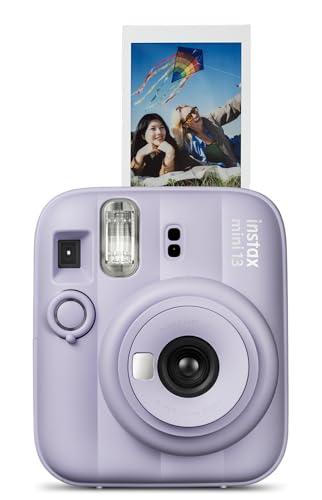
The best instant cameras for parties
Camera choice and film arithmetic by guest count.
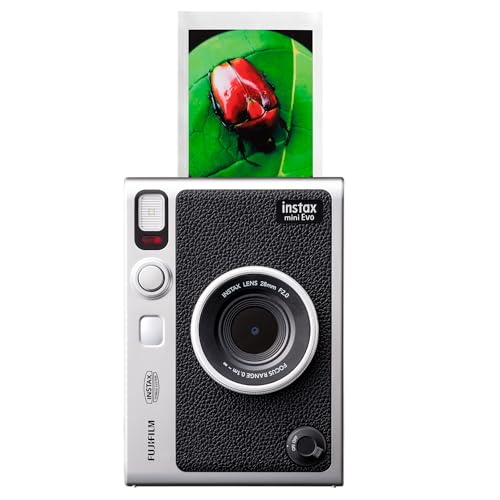
The best instant cameras for low light
What to buy when the venue is genuinely dark.
How much instant film do I need?
Turning a guest count into packs and dollars.
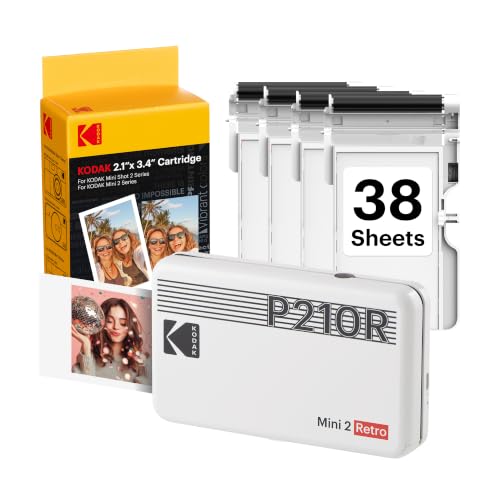
The best pocket photo printers
The no-wasted-film version of a booth.
Sources
- Fujifilm instax mini 12 specifications — Source of the 62 x 46 mm instax mini print dimension
- Fujifilm instax mini 99 specifications — Flash effective 0.3-2.7 m with indoor and slow-synchro modes, shutter 1.8 to 1/400 sec plus bulb up to 10 sec — the longest flash reach and the only bulb mode in the instax range
- Fujifilm instax SQUARE SQ40 specifications — 62 x 62 mm picture on 86 x 72 mm film, 65.75 mm f/12.6 lens, 1/2-1/400 sec shutter, Lv 5.0-15.5 at ISO 800, flash 0.3-2.2 m, 2 x CR2, 453 g
- Fujifilm instax SQUARE 2 specifications (US) — Manufacturer specification page, fetched 3 November 2026: 62 x 62 mm print, 65.75 mm f/12.6 lens, three shooting zones (close-up 0.3-0.5 m, standard 0.5-3.0 m, landscape 3.0 m and beyond), 0.4x reverse Galilean finder with target spot, 1/2-1/400 sec programmed electronic shutter with slow sync, auto exposure Lv 5.0-15.5 at ISO 800, flash 0.3-2.2 m with a recycle time of 7.5 sec or less, 4 x AA (LR6 or HR6), about 30 film packs per set, auto power off at 5 minutes, 139.0 x 119.5 x 71.0 mm, 450 g. No self-timer is listed
- Fujifilm instax WIDE 400 specifications — Source of the 99 x 62 mm instax WIDE print dimension, and of the camera's 0.9-3 m shooting range and 0.9-3 m flash range — the only instax that cannot focus closer than 0.9 m. Four AA batteries, 616 g
- instax — WIDE Evo specifications — Flash effective approximately 30 cm to 1.5 m — the shortest flash reach in the range
- Polaroid Flip product page (US) — Manufacturer specification: vacuum discharge tube strobe with a range of 4.5 m at f8, sonar autofocus across four zones from 0.4 m, up to 15 film packs per charge, 648 g — the longest verified flash reach of any camera in our registry
- Polaroid Now Generation 3 — Two-lens autofocus with zones 0.40-1.3 m and 1.0 m to infinity, f/11 to f/64, self-timer, double exposure and a built-in tripod mount — the only verified tripod mount in our registry
- Polaroid — Color i-Type film — $18.99 for 8 photos; 107 x 88 mm print with a 79 x 77 mm image area, ASA 640
- Pro Photo Supply — instax mini film, 20 exposures — $16.99 for 20 exposures on 13 October 2026 — the basis of the 85c-per-shot figure
Found something out of date or wrong? Tell us and we will correct it with a dated note. Our picks are re-checked quarterly — see our editorial policy.